Differential Pressure & Flow Meter FAQs
At Orange Research, we provide expert guidance on differential pressure and flow measurement solutions for industrial systems. From selecting gauges and flow meters to measuring pressure across filters, heat exchangers, and orifice plates, our instruments are engineered for accuracy, durability, and reliable performance in demanding environments. Use this FAQ to explore best practices, selection criteria, and our U.S.-made solutions for OEMs, engineers, and facility managers.
Frequently Asked Questions

Differential Pressure
How do I select a differential pressure gauge?
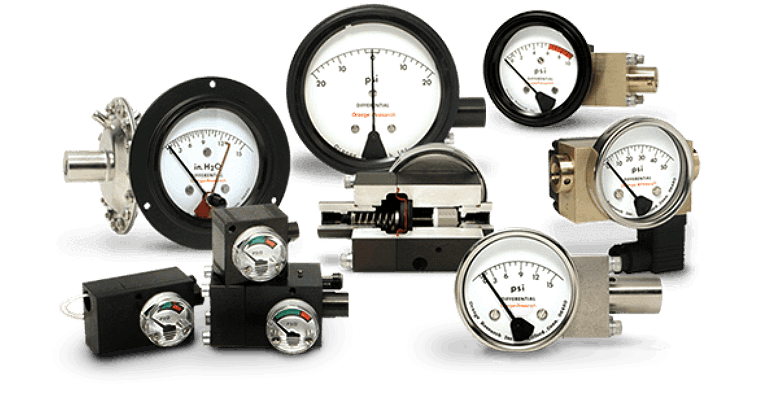
Choosing the right DP gauge requires understanding your application’s pressure range, media type, temperature, process connection, and mounting style. For liquids or gases, gauge materials must be compatible with the medium to prevent corrosion or damage. Orange Research offers a DP gauge selection guide to simplify this process. For existing systems using Barton gauges, consider our model 1536DG, a reliable, drop-in replacement built in the USA. For hazardous or volatile environments, explosion-proof models are available.
How do I select a differential pressure gauge for liquids?
Liquid applications require gauges with wetted materials compatible with the fluid, such as stainless steel, Teflon, or PVC. Consider viscosity, flow characteristics, and operating temperature. Orange Research DP gauges are calibrated for liquids, and many models can include switches or transmitters for monitoring system performance.
How do I select a differential pressure gauge for gas?
Gas measurement often demands gauges with fast response, minimal pressure drop, and corrosion-resistant materials. Ensure your DP gauge can handle low-pressure differentials typical of gas flow systems. Orange Research offers DP gauges and transmitters, including explosion-proof models, suitable for both air and industrial gases, with optional aluminum, stainless steel, or specialized construction.
How do you select a differential pressure gauge with a switch?
DP gauges with switches allow automatic alarm or control functions. Select a gauge with a switch rated for your electrical load, actuation point, and media compatibility. Orange Research offers models with adjustable or fixed set points to alert operators when thresholds are exceeded.
How do you select a differential pressure gauge with a transmitter?
DP gauges with transmitters convert pressure readings into electronic signals for remote monitoring or integration with SCADA/DCS systems. Ensure compatibility with your signal type (4-20 mA, voltage, or digital protocols), media, and pressure range. Orange Research provides gauges with integrated transmitters for seamless system integration.
Flow Control
How do I select a flow meter?
Selecting a flow meter depends on your fluid type, flow range, pressure, temperature, and required accuracy. Consider installation requirements (inline vs. insertion), maintenance, and compatibility with process media. Orange Research offers a wide range of flow meters for liquids and gases designed for industrial reliability.
How do I select a flow meter for liquids?
For liquids, choose a flow meter based on viscosity, corrosiveness, and required flow range. Variable area, turbine, or differential pressure flow meters are commonly used. Orange Research flow meters are engineered to handle water, chemical solutions, and industrial fluids, with optional switches or transmitters. Review our flow meter selection guide.
How do I select a flow meter for gas?
Gas flow measurement often requires flow meters that account for compressibility, pressure drop, and density changes. Differential pressure flow meters, thermal mass meters, and turbine meters are common choices. Orange Research provides gas-compatible flow meters with high accuracy and robust construction.

DP Measurement Across Equipment
How do you measure differential pressure across a filter?
Connect a DP gauge across the filter’s inlet and outlet ports to monitor pressure drop. An increasing differential indicates clogging or contamination. Orange Research DP gauges and switches are ideal for continuous filter monitoring in industrial systems.
How do you measure differential pressure across a heat exchanger?
Install the DP gauge across the inlet and outlet of the exchanger to monitor pressure drop, which can indicate fouling, scaling, or flow restrictions. Orange Research gauges are built to handle high temperatures and demanding process conditions.
How do you measure level in a cryogenic tank?
Level measurement in cryogenic tanks can be achieved with differential pressure transmitters or gauges, designed for extreme temperatures and liquefied gases. Orange Research offers solutions calibrated for LIN, LOX, LAR, and other cryogenic fluids, ensuring accurate and reliable monitoring. Find solutions by tank type.
How do you measure flow across an orifice plate?
Measure upstream and downstream pressures across the orifice plate using a DP gauge or transmitter. The differential pressure can be converted to flow using standard formulas. Orange Research DP gauges and transmitters are designed for orifice plate applications with durable construction and high accuracy.
Contact the Leaders in Filtration, Level and Flow Monitoring
For assistance selecting the right differential pressure or flow measurement solution for your system, contact Orange Research to speak directly with our engineering experts. Our U.S.-manufactured gauges, transmitters, and flow meters provide precision, reliability, and long-term durability across demanding industrial applications.



 WARNING: Some of our products contain Nickel, a chemical known to the State of California to cause cancer. For more information go to: